Article: Care Shoes vs. Clogs vs. Running Shoes
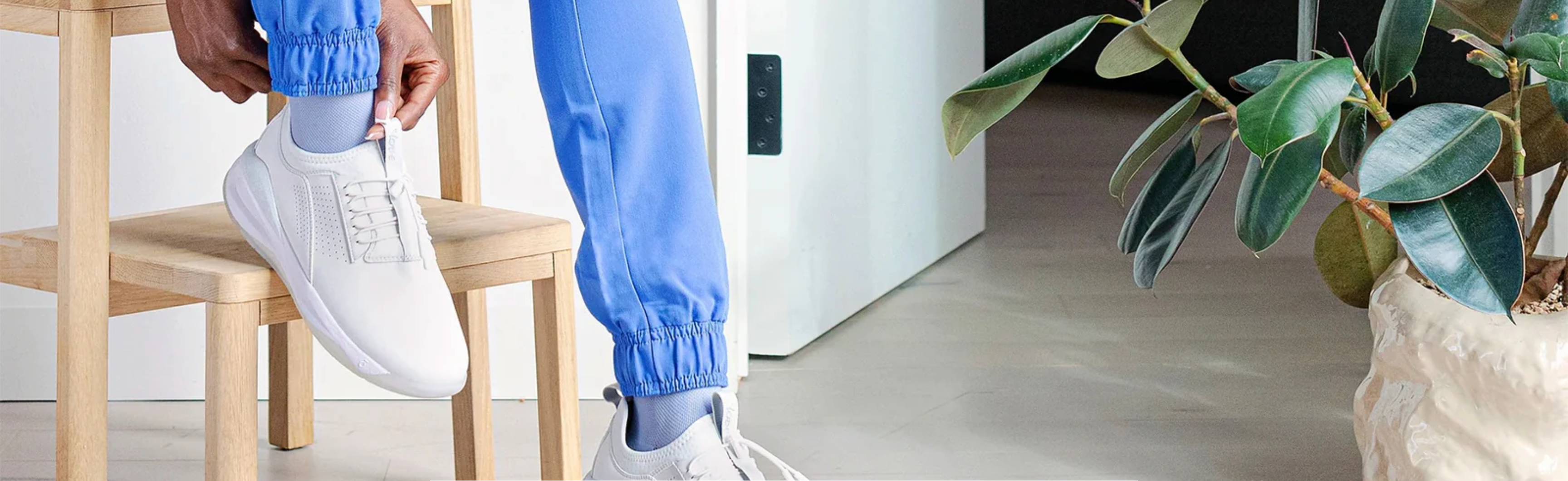
Care Shoes vs. Clogs vs. Running Shoes
August 26, 2025
Healthcare professionals spend many hours on their feet every day. The right footwear plays a crucial role in preventing fatigue, pain, and injuries. Traditionally, some professions opt for clogs, while others swear by running shoes. Recently, however, a new type of shoe has emerged that combines features of both, the care shoe such as the Clove Classic, Forte, and Strada.
In this article, we compare the three categories based on scientific insights into posture, strain, and comfort.
Clogs: stable but limited
Clogs have a long history in the medical world. Their main advantages are:
- Heel height and stability: a slightly raised heel creates a natural pelvic tilt, which often makes prolonged standing less taxing on the lower back.
- Hygiene and maintenance: many clogs are easy to clean, making them suitable for hospitals and clinics.
Yet clogs have clear limitations:
- Limited cushioning: the hard sole absorbs little shock, which can make walking longer distances tiring.
- Reduced flexibility: the rigid construction doesn't always support the foot's natural roll.
Research shows that prolonged use of hard, poorly cushioned shoes increases the risk of foot and knee pain, particularly for professionals who cover a lot of ground during their workday

Running shoes: optimal for movement, less so for standing still
Running shoes are designed for dynamic strain. Their advantages are:
- Excellent shock absorption: ideal for repetitive strain such as running or a lot of walking.
- Lightweight and flexible: support a natural walking motion and reduce impact on the joints.
However, where running shoes perform well during movement, they fall short during prolonged standing:
- Excessive cushioning under static load: soft midsoles can cause instability during hours of standing.
- Design geared toward forward roll: the biomechanics of running shoes are tuned for movement, not static load.
Studies confirm that prolonged standing in running shoes can lead to foot muscle fatigue and reduced postural stability.
Clove shoes: a hybrid solution
Clove shoes combine the advantages of both worlds:
-
Heel height like clogs: creates better spinal alignment and less strain during prolonged standing.
-
Comfortable sole with running technology: cushioning and support suited to long walking distances, without the shoe losing its stability.
- Support for both static and dynamic strain: this makes the shoe usable in situations where professionals both stand still for long periods and walk a lot during a workday.
This design meets the need for multifunctional shoes: they provide stability while standing still and absorb shocks while moving.

Comparison at a glance
|
Feature |
Clogs |
Running shoes |
Clove care shoes |
|
Suitable for prolonged standing |
Yes, due to raised heel |
Less suitable (instability) |
Yes, stable due to heel height |
|
Suitable for a lot of walking |
Less (little cushioning) |
Excellent (designed for movement) |
Yes, cushioning comparable to running shoes |
|
Biomechanical balance |
Rigid, limited flexibility |
Forward-oriented, less stable when standing still |
Combination: stable and cushioned |
Conclusion
The choice of professional footwear depends heavily on the nature of the strain involved.
Clogs are stable and hygienic, but limiting when you walk a lot.
- Running shoes are excellent for movement, but less suitable for prolonged standing.
- Shoes developed specifically for healthcare, such as Clove, combine the benefits of both: stability during prolonged standing and comfort and cushioning during a lot of walking.
For professionals who both stand a lot and move a lot during their workday, shoes with these hybrid properties offer a scientifically grounded alternative that contributes to posture, comfort, and the durability of the musculoskeletal system.