Why running shoes are often too soft for prolonged standing in healthcare
October 23, 2025
You know the feeling: you walk into a sports store, try on the newest running shoes with thick foam soles, and it feels like you're walking on clouds. "This is exactly what I need for my 10-hour shift," you think.
Yet at the end of your workday you come home with tired legs, aching calves, and a sore lower back. How can that be? Weren't those shoes supposed to be so soft?
It sounds contradictory, but in healthcare, that extreme softness is often exactly the enemy. In this blog, we explain why running shoes aren't anatomically built for the work you do, and why firmness is the key to pain-free work.
Running vs. Caregiving: A completely different kind of strain
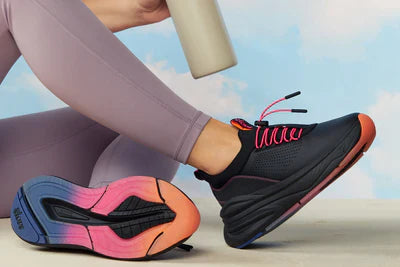
Running shoes are, as the name suggests, designed for running. While running, you land on your heel or midfoot with a lot of force. The shoe has to absorb that impact and launch you forward again ('energy return'). Soft, springy foam is ideal for that.
But now look at what you actually do in a day:
-
You stand still for long periods at the operating table or at a patient's bedside.
-
You make short, quick movements and pivot a lot.
-
You lift patients or heavy equipment.
This is static strain. Your body doesn't need to absorb the impact of running, but has to keep itself upright and balanced for hours on end.
The problem with the "walking on clouds" effect
Imagine having to stand on a very soft mattress. That feels great for the first minute, but after fifteen minutes your muscles start to tremble. Why? Because the surface is unstable.
The same thing happens with overly soft running shoes in healthcare:
-
You lose stability: Because the sole compresses, your body has to work continuously hard to keep your ankles and knees aligned. This happens unconsciously through tiny micro-movements of your muscles.
-
Energy loss: All that unconscious correcting costs energy. This is why your legs feel so heavy by the end of the day, even if you haven't covered that many kilometers.
-
Strain on the fascia: If your heel sinks too deep into soft foam, more tension is placed on your Achilles tendon and the fascia under your foot. Over the long term, this can lead to heel spurs.
Why Clove chooses "firm support"
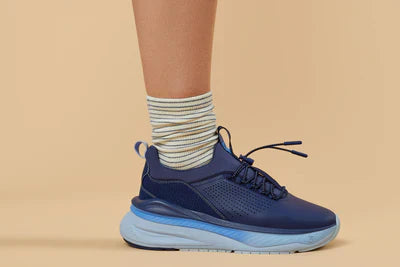
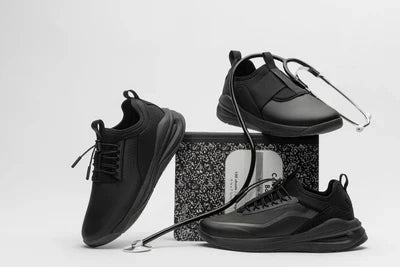
When designing Clove care sneakers, we looked at what a healthcare professional really needs. The answer isn't softness, but stability.
Our soles are made from a specific EVA blend that feels comfortable but doesn't sink.
-
Foundation: Think of your shoes as the foundation of a house. You don't want to build that on quicksand, but on concrete. Our firm sole ensures that your skeleton is well supported, which carries through to your knees, hips, and back.
-
Shock absorption without wobble: Clove does provide cushioning, but it's responsive. It absorbs the impact of walking, while giving you a stable platform the moment you stand still.

The test: Are your shoes too soft?
Not sure if your current shoes are the cause of your complaints? Try the following check:
-
Can you easily fold the sole of your shoe in half or twist it like a pretzel? Then it's probably too unstable for standing work.
-
Does it feel like you're "sinking" into the heel when you stand still?
-
Do you feel like your ankles are "tired" by the end of the day?
Conclusion: Choose the right tool
You wouldn't perform surgery with kitchen tools. So why would you provide care in shoes made for running marathons?
Running shoes are fantastic for your jog through the park, but on the work floor, your feet deserve the stability of a real care sneaker. With Clove, you choose a shoe that actively supports you, so you can put your energy into your patients, not into staying upright.
Curious about the difference? Check out our care sneakers here.